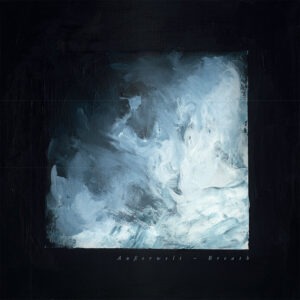
| Band: | Außerwelt |
| Release: | Breath |
| Genre: | Post-Metal |
| Country: | Germany (Münster) |
| Release Date: | 02.10.2025 |
| Released via: | Moment of Collapse Records |
| Mix and Master: | Dennis Koehne |
| Produced by: | Dennis Koehne, Kris Lucas |
| Recording: | Kris Lucas, Manuel Klein, Meredith Schmiedeskamp |
| Illustrations: | Carmen Alba |
| Layout: | Dana Wolter |
Some albums are released and you instantly know you should be giving them your full attention. And yet, weeks – sometimes months – pass. Breath, the debut full-length by AUßERWELT, is exactly that kind of record for me. Released in autumn 2025 via Moment of Collapse Records, it has long since begun to make its mark – and I admittedly failed to give it the timely attention it so clearly deserved. All the more reason why this review is not a belated filler, but a necessary acknowledgement of an album that stands out as one of the most compelling genre statements in recent memory.
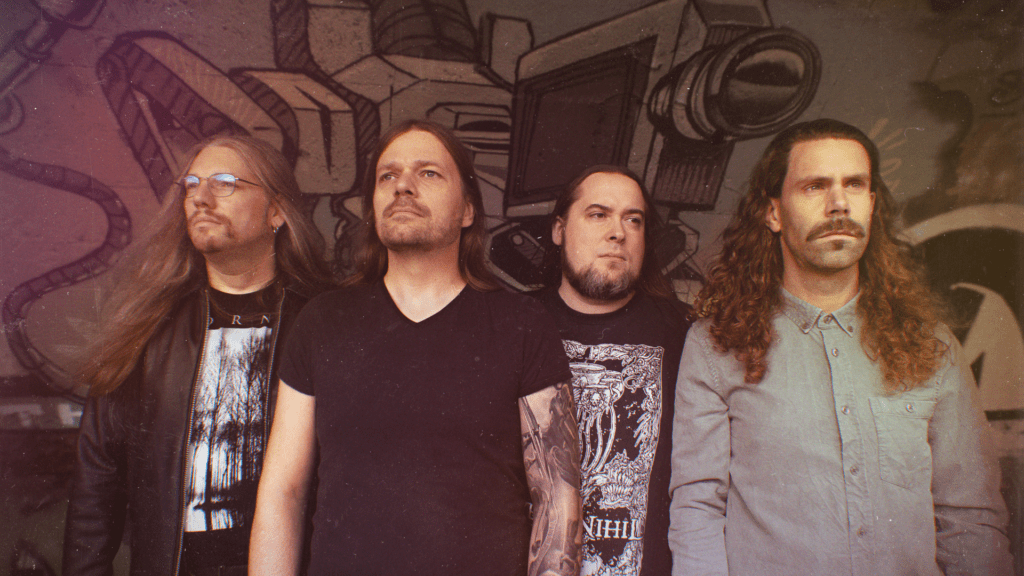
With Breath, the Münster-based quartet deliver their first full-length after more than a decade of shared evolution. Across 63 minutes, the band offer more than a mere statement of intent – they demonstrate that Post-Metal can still surprise when treated not as a rigid template, but as an open and evolving framework.
Post-Metal without the template
The stylistic markers are familiar enough: the music draws on multiple strands of extreme and experimental heavy music, blending the restless tension of Black Metal, the crushing density of Death Metal, the direct emotional punch of Post-Hardcore and a clear affinity for progressive song structures. Yet AUßERWELT avoid the genre’s most predictable habits. The common loud–soft–loud dynamic – so often reduced to formula – rarely feels mechanical here. The shifts on Breath unfold less like calculated crescendos and more like internal necessity.
Tracks such as “Breath” and “While The Ruins Still Linger” highlight the band’s ability to move between controlled dissonance and expansive release without sounding schematic. Riffs evolve instead of merely repeating. The rhythm section does more than provide foundation, it subtly redirects momentum. The result is a sense of organic motion that sets the album apart from many of its peers.
Space as a compositional tool
What truly distinguishes Breath is its relationship to space. Where many bands in the Post-Metal sphere pile on layers to achieve monumentality, AUßERWELT understand restraint. Even in the densest passages, there is air in the mix – room for details to surface. The DIY recording process, carried out in the band’s own studio, does not feel limiting, it feels intentional.
The mix grants the album both heft and clarity. Harsh vocals cut sharply through the instrumentation, while clean singing and piano passages function as emotional anchors rather than decorative contrasts. The ambient interludes, “Finite/Solitaire” and “Eyes To The Sea”, are not mere breathers between assaults but structural pivots, subtly reframing what surrounds them.
Fittingly, Breath has also been released in two colored vinyl pressings (orange and clear) – a format that suits the album’s patient pacing and immersive flow particularly well.
Darkness without posturing
Lyrically and thematically, Breath navigates tension between exhaustion and resilience. The motif of breathing operates less as rigid concept and more as structural principle: compression, release, recovery. Unlike much of the genre’s more self-indulgent bleakness, AUßERWELT do not fetishize despair. There is darkness here, certainly – but not nihilistic theatrics.
This underlying sense of reflection – even quiet defiance – gives the record a distinct character. It feels engaged rather than escapist, emotionally exposed without sacrificing intensity. The human element never disappears beneath the distortion.
Minor flaws, lasting impact
The album is not without minor weaknesses. In its middle stretch, the pacing occasionally threatens to plateau, and a few transitions could have been carved with sharper edges. Yet even these moments feel less like missteps and more like measured pauses within a larger arc.
Ultimately, Breath stands as an impressively cohesive record – not flawless, but fully convinced of its own vision. It does not beg for attention, it earns it.
Perhaps the delay in addressing this album was not entirely misplaced. Some records benefit from time – from distance. For me, Breath is one of them.